
Safety Culture Tools
for Child Welfare Leaders
Leading in Workplace Culture
Leaders pave the path for workplace culture, and all the “little things” – in sum – make a difference. Being accessible, attentive, committed and honest are critical. Leading with a willingness to model vulnerability by admitting a mistake or describing a weakness is challenging but can be rewarding. Sharing accountability for decisions and participating in your own skill-building through programs like reverse mentoring also have an impact.
Sustaining a Safety Culture in the Context of Learning and Improvement
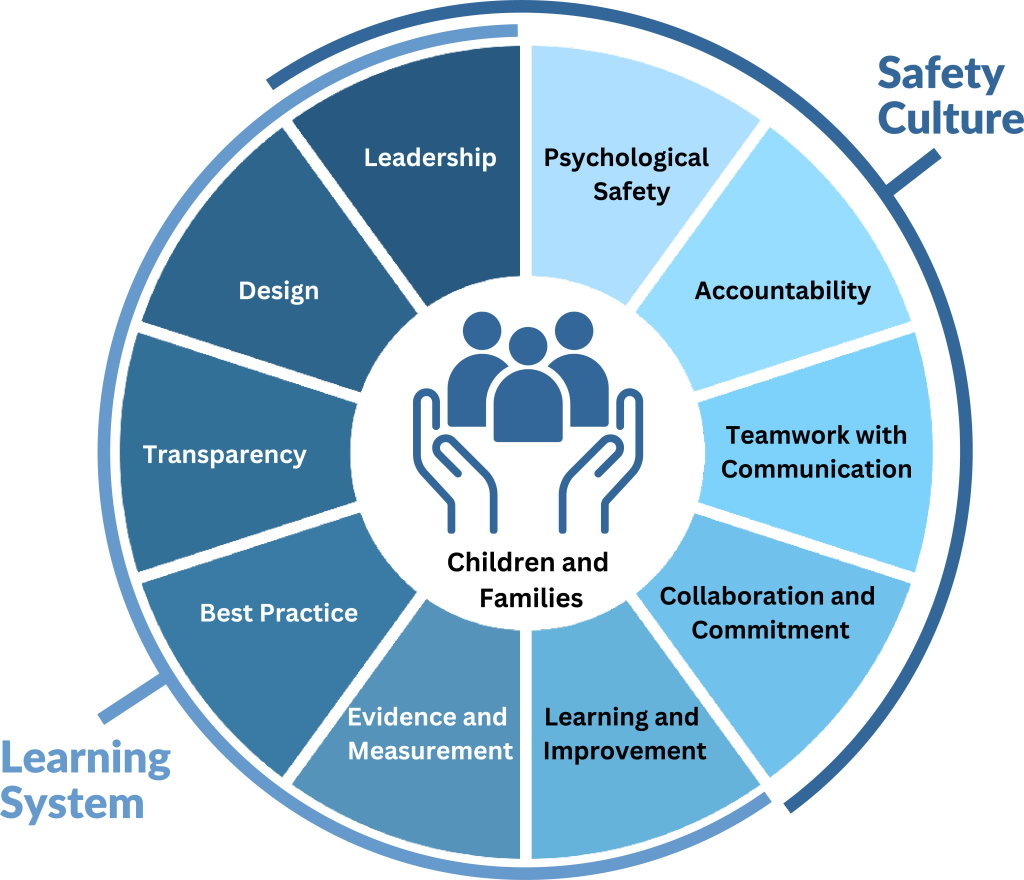
Adapted from the Institute for Healthcare Improvement’s White Paper on Safe, Reliable and Effective Care, the image below visualizes how leaders elaborate and sustain a Safety Culture in the context of learning and improvement. Leadership is central to this work and the integration of safety culture and learning.
Resources for Leaders
All the resources within the WisconsinWell are intended to be useful to leaders.
In your unique role, you may also consider three actions:
1
Celebrating Safety over Heroism
The stories we share promote attention to what we want others to emulate. In Safety Cultures, we are careful what we celebrate. Without intention, we can elevate unsafe work practices. For example, a caseworker who works without rest for 30 hours straight, a transporter who drives a child across two state lines without stopping, or a supervisor who agrees to take on an entire caseload while still supervising their team – these are not circumstances to celebrate. They may have gotten the job done, but those are not safe decisions.
Our systems need better designing to identify, respond and prevent these overtaxing situations, and we actually need to celebrate professionals who resist giving into these behaviors and instead insist on teamwork – encouraging organized hand-offs, collaborative casework practice, and normalized boundaries to promote safety and recognize natural human limitations.
2
Engage Staff Where They Are
Resilience Rounds, adapted from Leadership Walk Arounds – are an expressed, recurrent commitment by senior leaders to meet directly with those working “at the point of care.” In a child welfare context, it refers to senior leaders meeting with small groups of direct care professionals and asking about issues affecting their safety and success as well as the safety and success of children and families. Resilience Rounds are a high priority for leaders in a Safety Culture, as they demonstrate the leadership’s candor and commitment to systems thinking, facilitate relationship building, lower the threshold for “speaking up” to leaders, and foster a willingness to share accountability in improvement work.
3
Practice Balanced Accountability
Striving for practical and effective accountability practices is easier said than done, especially when emotions are high and pressures are mounting. There is no universally “right” and prescriptive approach for healthy accountability practices yet following some guiding principles within a basic mental model is a good place to start. The attached guide offers some basic considerations and an assessment strategy in understanding how to balance individual and systems accountability within a Safety Culture.